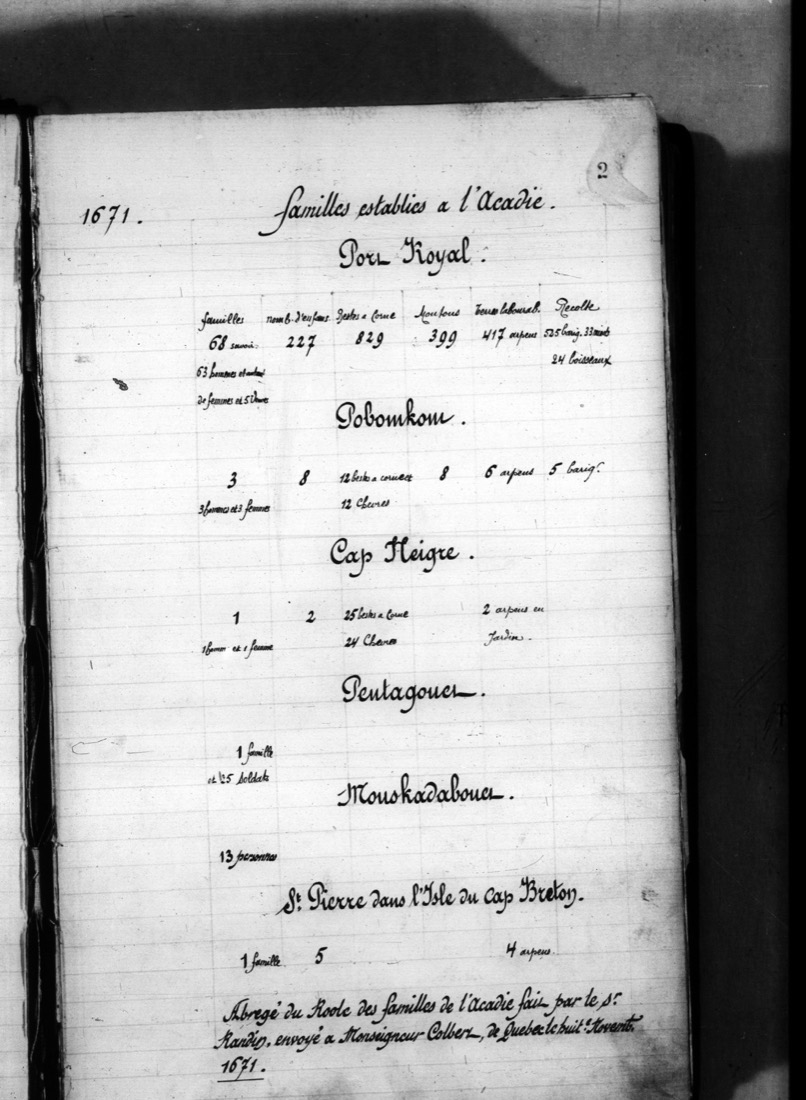
In 1639 the French post at Port-Royal, in what is now Annapolis Royal, Nova Scotia, was a fort, a chapel and a few dozen families clearing marsh along the river. Its commander was Charles de Menou d'Aulnay. That year his daughter Marie was baptised, and the entry is one of the earliest records of the Acadian community.1
The godmother was a young girl, "Jeanne Traihan fille de Guillaume Traihan mareschal": Jeanne Trahan, daughter of Guillaume Trahan the smith. The entry also says the child was presented by Claude Petitpas and Michel Boudrot, the colony's first syndics, the elected spokesmen of the settlers.
"…par Claude Petitpas et M. Boudrot premiers sindics du port Royal." Port-Royal register, 1639, as quoted by WikiTree
Three of the names on that page are direct ancestors of this family. Jeanne Trahan later married the surgeon Jacques Bourgeois, and their son Germain founded Beaubassin. Michel Boudrot, the syndic, is an ancestor twice over, by two separate lines.
The smith from Bourgueil
Guillaume Trahan came from the Loire valley, the country of Chinon and Bourgueil. He married Françoise Corbineau at Saint-Étienne in Chinon on 13 July 1627, and nine years later signed on for the New World. The passenger roll of the Saint-Jehan, dated 1 April 1636, lists "Guillaume Trahan, an edge-tool maker, with his wife and two children". An edge-tool maker forged axes, scythes, adzes and billhooks, the tools a colony lives or dies by.2
He became one of the colony's leaders. When an English force from Boston took Port-Royal in the summer of 1654, it was Guillaume Trahan who signed the capitulation for the inhabitants, on 16 August.
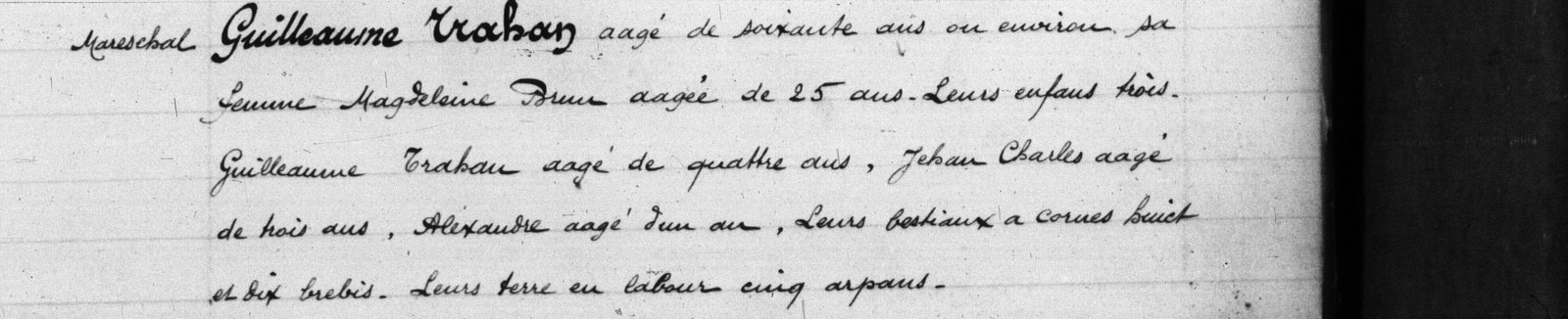
Read the transcription
"Mareschal. Guilleaume Trahan aagé de soixante ans ou environ, sa femme Magdeleine Brun aagée de 25 ans. Leurs enfans trois. Guilleaume Trahan aagé de quatre ans, Jehan Charles aagé de trois ans, Alexandre aagé d'un an. Leurs bestiaux a cornes huict et six brebis. Leurs terre en labour cinq arpans."
The census of 1671 still found him at his trade: eight head of cattle, six sheep, five arpents under the plough, and three little boys born when he was in his sixties. He died before the end of 1684.
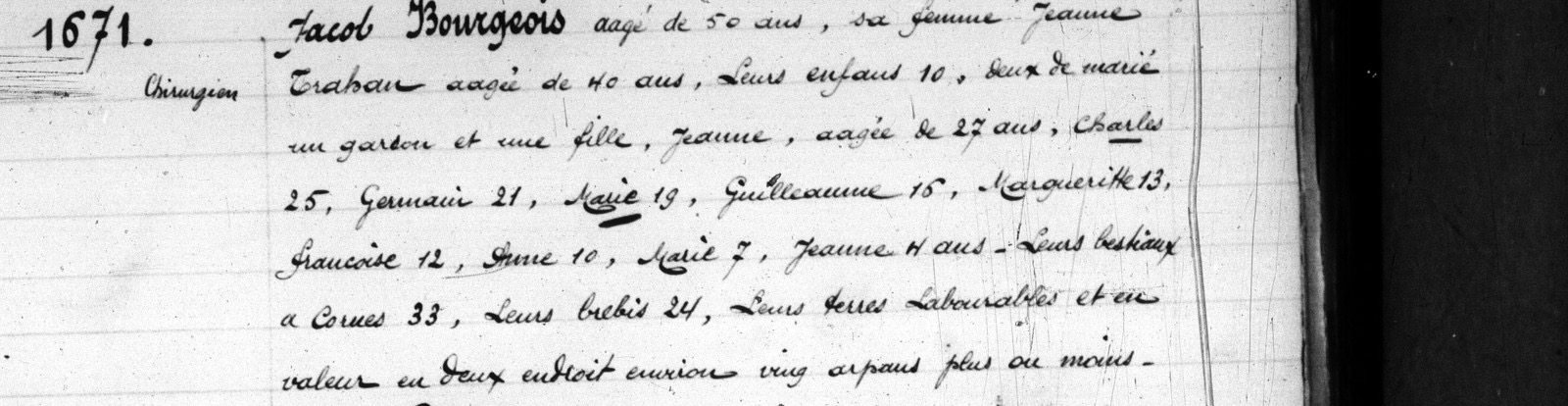
Before there was an Acadia in any history book, these families were already standing together at a font in a wooden chapel at the edge of the continent.